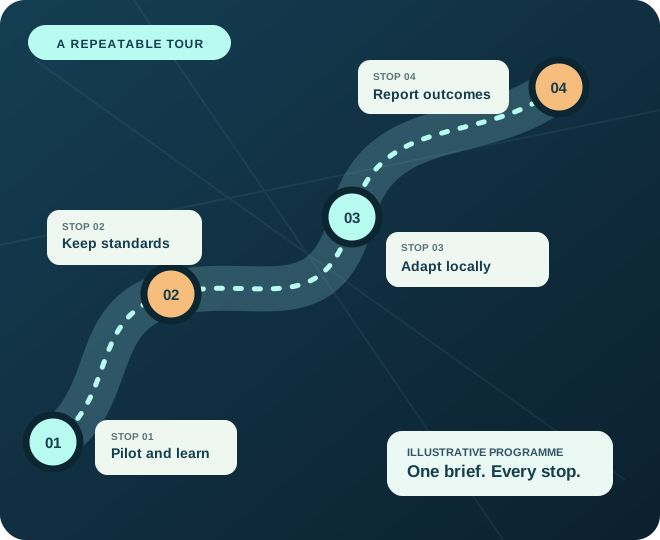
London is a sensible coordination base for national brand tours, but the planning challenge starts after the flagship stop. A roadshow must perform repeatedly across different venues without losing the brand experience.
What this service is designed to solve
Our scope may include route design, creative and production briefs, reusable assets, location liaison, local crew requirements, replenishment and reporting.
The work to scope before a quotation
Central production schedule; first-stop sign-off; individual stop sheets; journey and logistics model; budget assumptions; incident escalation tree.
To build a dependable proposal, start with the intended audience, the target date or date range, the campaign format, the number of locations and a realistic budget bracket. Where the client already controls a venue, store, supplier or piece of equipment, that can materially change the plan. Where nothing is booked yet, the first phase should validate those assumptions rather than describe them as secured.
The operational reality
London operations do not establish blanket permission or supplier coverage in other cities. All site-specific and transit requirements need confirmation.
The commercial proposal should make clear who approves the concept, who signs off the site and which activities are delivered by specialist partners. We separate fixed production elements from location-dependent variable costs; that keeps the client in control if the scope changes before launch.
A sensible measurement plan
A good London pilot should produce a tested playbook that makes each next stop more predictable and easier to price.
Before launch, agree precisely what counts as an engagement, a qualified enquiry, a product trial or a conversion. Keep opt-in customer data and anonymised activity counts distinct. The final report should identify both observed outcomes and evidence gaps. This is more useful for a repeat programme than a single unqualified headline number.
What to include in the initial enquiry
- Locations and permissions: what is confirmed, preferred or still awaiting approval.
- Audience and objective: who needs to act and what action matters.
- Physical footprint: available floor area, power, storage and access conditions.
- People and production: likely staff roles, creative assets, product stock and specialist requirements.
- Dates and budget: firm deadlines, flexibility, buying authority and intended spending range.
- Success measure: how an outcome will be captured and who owns customer follow-up.
Frequently asked question
Can you organise a roadshow starting in London?
We can develop a London-first plan and validate each subsequent location, supplier and delivery date.
Start with a real brief
Share the campaign objective and the operating constraints. We will distinguish what is possible from what still needs supplier or site verification before preparing a detailed proposal. Discuss a campaign.
Plan nationally; use London as the coordination point
London may suit kick-off, supplier meetings and flagship activations, but a multi-city programme must be costed for the whole route.
- Flagship versus rollout: decide what should be proven in London before assets travel.
- Travel: calculate crew arrival windows, overnight stays and loading restrictions at later stops.
- Partners: specify any local staff, vehicles or contractors needing confirmation.
- Reporting: keep one operational record and quality standard throughout the programme.
The buyer decision: London headquarters does not imply existing premises, staff or approved suppliers in every European city.