Primary action: Plan your multi-city tour
The hard part of a multi-city roadshow is not choosing the next postcode. It is knowing the activation can operate consistently when the venue, crew, footfall, access window and supplier team change. A campaign needs a central standard and a local reality check at every stop.
What stays consistent—and what changes
A strong touring model protects its customer journey, brand assets, talking points, quality requirements and reporting. Venue layouts, lead time, security, vehicle access, staffing restrictions and day-to-day stock demand vary. Build for both facts rather than pretending every city has the same conditions.
A roadshow readiness checklist
- Route assumptions: Why those cities? Confirm audience density, time between stops, travel days and blackout dates.
- Venue readiness: Booking owner, vehicle access, load-in hours, power, local permits, risk assessments and any restrictions on sampling, noise or filming.
- Asset reuse: Structures, branded materials, equipment, weights, packing, maintenance, storage, shipping and asset ownership.
- Field operations: Producer authority, crew brief, emergency contacts, staff substitutes and a standard programme diary.
- Stock and replenishment: Volume assumptions, consumption tracking, regional storage, return logistics and contingency.
- Reporting: Stop ID, operating hours, actual visitors/interactions, opt-in leads where lawful, qualitative observations and issues requiring changes.
How the costs usually behave
Strategy and creative development may apply once. Fabrication may be reusable. Staff, travel, venue, shipping, equipment servicing, local approvals and consumables scale with the itinerary. A competent quotation makes that distinction visible so it is possible to compare a three-stop pilot with a ten-stop expansion without hiding costs.
The role of a central producer
A single accountable producer should approve the final runbook and control changes across locations. That does not mean every role must be 'in house'; it means supplier responsibilities, approvals and communication are visible. Poor escalation makes small problems repeat across the tour.
For campaigns designed to get people to take a commercial action, explore roadshow marketing. For product demonstrations, see product-launch roadshows.
Tell us the cities, target audience, approximate number of dates and expected experience. Send a working brief.
The route is one campaign, not a collection of unrelated events
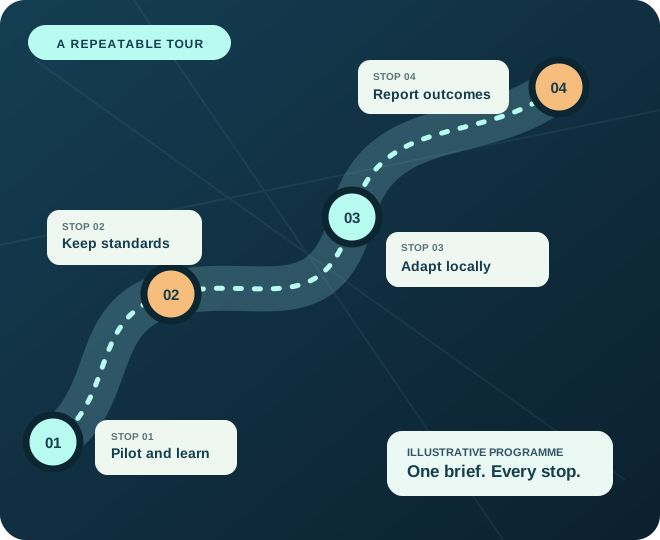
A national route needs a portable brand standard and a practical plan for the differences between sites. Touring consistency is earned through preproduction.
- Route logic: sequence stops using audience value, travel conditions, installation time and operating dates—not simply a neat line on a map.
- Asset repeatability: agree what can travel, what needs local sourcing and how damaged equipment is replaced.
- Local approvals: named site contacts, site surveys, parking, access, power, permits and acceptable noise or sampling.
- Reporting: consistent metrics across stops, a campaign change log and a final cross-location review.
The buyer decision: Use the live planning scoper below to estimate stop-days, crew-days and travel transitions before requesting a quotation.
An illustrative six-stop programme
Suppose a brand wants six UK stops, each with one live event day and one set-up day, supported by four site crew. The operating footprint is six live event-days, twelve site-days including setup and forty-eight crew-days before any travel time. There are also at least five transitions between locations.
Those numbers are straightforward arithmetic, not a supplier quote. The expensive questions are which days can share kit, where the team sleeps, which sites can accept the installation and how long it takes to load in and out. Use the scoper below to change these assumptions.