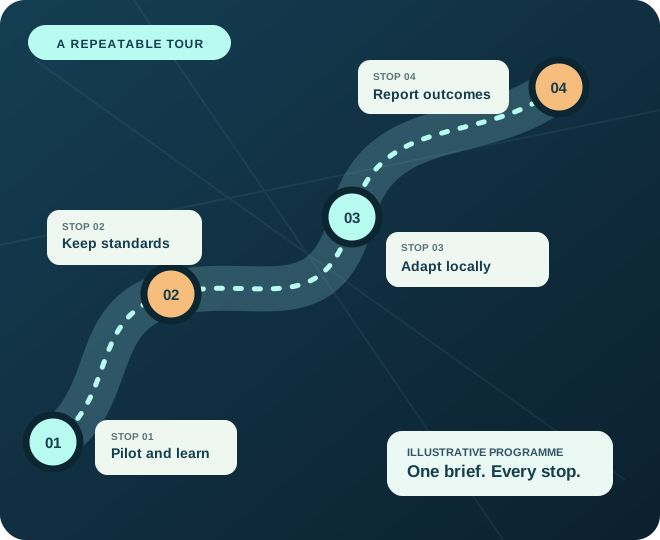
A national roadshow is a sequence of individual delivery days connected by one brand standard and one operational system. That system must survive travel time, handovers and changing audiences.
What this service is designed to solve
A UK tour can support consumer trial, employer branding, dealer education, channel partnerships or enterprise product launches. The right route depends on audience fit, not simply the largest cities.
The work to scope before a quotation
Route scorecard; stop economics; asset plan; reusable visual toolkit; briefed staff; delivery and escalation matrix; site-by-site results.
To build a dependable proposal, start with the intended audience, the target date or date range, the campaign format, the number of locations and a realistic budget bracket. Where the client already controls a venue, store, supplier or piece of equipment, that can materially change the plan. Where nothing is booked yet, the first phase should validate those assumptions rather than describe them as secured.
The operational reality
Multiple dates are provisional until venues, vehicles, staff and specialists confirm them. The scope should state dependencies for Scotland, Wales and Northern Ireland where relevant.
The commercial proposal should make clear who approves the concept, who signs off the site and which activities are delivered by specialist partners. We separate fixed production elements from location-dependent variable costs; that keeps the client in control if the scope changes before launch.
A sensible measurement plan
Each stop should improve the next through comparable reporting and rapid operational feedback.
Before launch, agree precisely what counts as an engagement, a qualified enquiry, a product trial or a conversion. Keep opt-in customer data and anonymised activity counts distinct. The final report should identify both observed outcomes and evidence gaps. This is more useful for a repeat programme than a single unqualified headline number.
What to include in the initial enquiry
- Locations and permissions: what is confirmed, preferred or still awaiting approval.
- Audience and objective: who needs to act and what action matters.
- Physical footprint: available floor area, power, storage and access conditions.
- People and production: likely staff roles, creative assets, product stock and specialist requirements.
- Dates and budget: firm deadlines, flexibility, buying authority and intended spending range.
- Success measure: how an outcome will be captured and who owns customer follow-up.
Frequently asked question
Can one agency manage the full tour?
The proposed model can establish one accountable lead and specialist suppliers, but contracts and responsibilities are confirmed during scoping.
Start with a real brief
Share the campaign objective and the operating constraints. We will distinguish what is possible from what still needs supplier or site verification before preparing a detailed proposal. Discuss a campaign.
What the UK rollout brief must not omit
A UK-wide campaign is a series of local permissions and transport decisions joined by one national standard.
- Weather resilience: agree indoor fallback and equipment limits wherever weather is material.
- Route transitions: include real pack-down, loading, driving, rest and reinstallation assumptions.
- Local site management: get the correct venue and access holder into the approval chain.
- Service levels: determine what happens if a vehicle, host or site becomes unavailable.
The buyer decision: Treat every proposed stop as conditional until it is approved and has a responsible delivery owner.