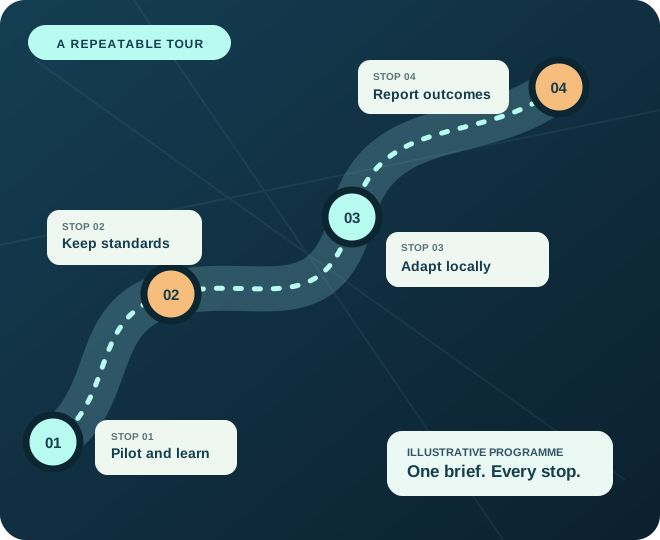
A roadshow needs consistent behaviour across its whole route, even when local staff change. A brand experience should not rely on one excellent team member being at every stop.
What this service is designed to solve
Roles may include activation hosts, presenters, sampling staff, team leads, tech operators and stage support. Specialist qualifications and legal eligibility are checked individually.
The work to scope before a quotation
Role matrix; site coverage plan; briefing and rehearsal; shift and break requirements; escalation contacts; photo and privacy rules; staff check-in reporting.
To build a dependable proposal, start with the intended audience, the target date or date range, the campaign format, the number of locations and a realistic budget bracket. Where the client already controls a venue, store, supplier or piece of equipment, that can materially change the plan. Where nothing is booked yet, the first phase should validate those assumptions rather than describe them as secured.
The operational reality
Staffing availability is not guaranteed until suppliers and crew are booked. Travel time, accommodation and local employment requirements affect cost.
The commercial proposal should make clear who approves the concept, who signs off the site and which activities are delivered by specialist partners. We separate fixed production elements from location-dependent variable costs; that keeps the client in control if the scope changes before launch.
A sensible measurement plan
Report quality of customer conversations and operational consistency as well as attendance.
Before launch, agree precisely what counts as an engagement, a qualified enquiry, a product trial or a conversion. Keep opt-in customer data and anonymised activity counts distinct. The final report should identify both observed outcomes and evidence gaps. This is more useful for a repeat programme than a single unqualified headline number.
What to include in the initial enquiry
- Locations and permissions: what is confirmed, preferred or still awaiting approval.
- Audience and objective: who needs to act and what action matters.
- Physical footprint: available floor area, power, storage and access conditions.
- People and production: likely staff roles, creative assets, product stock and specialist requirements.
- Dates and budget: firm deadlines, flexibility, buying authority and intended spending range.
- Success measure: how an outcome will be captured and who owns customer follow-up.
Frequently asked question
Can the same brand ambassadors travel across the UK?
That can be assessed, but the financial and working-time implications may make regional teams preferable.
Start with a real brief
Share the campaign objective and the operating constraints. We will distinguish what is possible from what still needs supplier or site verification before preparing a detailed proposal. Discuss a campaign.
People are part of the touring asset
Recreating a brand experience in different cities depends on consistent training, management and escalation, not merely booking a person for each stop.
- Training: approved product and brand scripts, example interactions and safety rules.
- Scheduling: travel, breaks, overnight stays, local replacements and realistic setup/derig hours.
- Supervisor controls: site checklists, standards observations and immediate issue reporting.
- Continuity: a named person to make the final call on substitutions and client-facing changes.
The buyer decision: A lower shift cost is not necessarily a lower programme cost once travel, supervision and quality control are included.