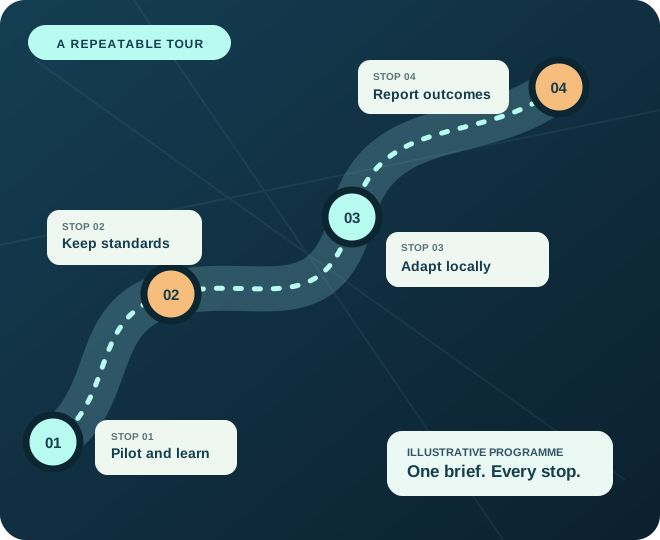
A strong roadshow agency proposal should explain exactly what will happen before, during and after each stop—and what is still being validated.
What this service is designed to solve
Ask who owns the master schedule, what assets are reusable, how cancellations work, who supplies local staff and how campaign-level results will be assembled.
The work to scope before a quotation
Clear ownership; itemised build and per-stop costs; realistic route assumptions; supplier dependencies; escalation process; end-of-programme report.
To build a dependable proposal, start with the intended audience, the target date or date range, the campaign format, the number of locations and a realistic budget bracket. Where the client already controls a venue, store, supplier or piece of equipment, that can materially change the plan. Where nothing is booked yet, the first phase should validate those assumptions rather than describe them as secured.
The operational reality
Avoid promises of guaranteed attendance or outcomes. Confirm supplier capacity, insurance, permissions and commercial exclusions before accepting a quotation.
The commercial proposal should make clear who approves the concept, who signs off the site and which activities are delivered by specialist partners. We separate fixed production elements from location-dependent variable costs; that keeps the client in control if the scope changes before launch.
A sensible measurement plan
The simplest useful proposal identifies the major unknowns and how they will be resolved.
Before launch, agree precisely what counts as an engagement, a qualified enquiry, a product trial or a conversion. Keep opt-in customer data and anonymised activity counts distinct. The final report should identify both observed outcomes and evidence gaps. This is more useful for a repeat programme than a single unqualified headline number.
What to include in the initial enquiry
- Locations and permissions: what is confirmed, preferred or still awaiting approval.
- Audience and objective: who needs to act and what action matters.
- Physical footprint: available floor area, power, storage and access conditions.
- People and production: likely staff roles, creative assets, product stock and specialist requirements.
- Dates and budget: firm deadlines, flexibility, buying authority and intended spending range.
- Success measure: how an outcome will be captured and who owns customer follow-up.
Frequently asked question
How early should we involve a roadshow agency?
Before dates and cities are locked, where possible, so route and production assumptions can influence the brief.
Start with a real brief
Share the campaign objective and the operating constraints. We will distinguish what is possible from what still needs supplier or site verification before preparing a detailed proposal. Discuss a campaign.
What a strong agency answer sounds like
Ask: “What happens if stop four loses venue access?” A credible response should name the decision owner, the stop-cancellation threshold, how crew and equipment are redirected and which costs change.
Ask: “Can we compare the cities?” The reply should define the same engagement and lead fields at every stop, account for different audiences and explain how missing sales data will be reported.
Ask: “Who owns the equipment?” The answer should distinguish client-owned assets, agency-managed suppliers and rented equipment with return and damage obligations.